Get Free Ebook The Age of Empathy: Nature's Lessons for a Kinder Society
Required some amusement? In fact, this publication doesn't only pay for the understanding reasons. You could set it as the added entertaining reading material. Discover the factor of why you enjoy this book for fun, too. It will certainly be a lot higher to be part of the wonderful readers worldwide that read The Age Of Empathy: Nature's Lessons For A Kinder Society as there referred publication. Now, just what do you consider the book that we give here?
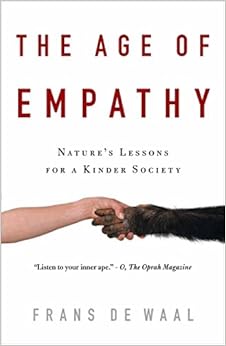
The Age of Empathy: Nature's Lessons for a Kinder Society

Get Free Ebook The Age of Empathy: Nature's Lessons for a Kinder Society
Be one of the lucky individuals that get the book from a popular author now. Please welcome The Age Of Empathy: Nature's Lessons For A Kinder Society Yeah, this is a type of famous book to be best seller as well as updated now. When you have take care of this sort of topic, you should get it as your resource. This is not just a publication that you need, however also a publication that is so interesting.
This is one of the means when you have no fiend back then; make the book as your true pal. Also this is not kind of talk-active thing, you could make brand-new mind and obtain new motivations from the book. From the literary book, you could get the amusement as when you enjoy the motion picture. Well, discussing guides, in fact what sort of book that we will recommend? Have you become aware of The Age Of Empathy: Nature's Lessons For A Kinder Society
Publication has the new info as well as lesson every time you review it. By reviewing the material of this publication, even few, you can get exactly what makes you really feel satisfied. Yeah, the presentation of the understanding by reviewing it might be so small, but the influence will be so fantastic. You could take it more times to understand more regarding this book. When you have actually completed content of The Age Of Empathy: Nature's Lessons For A Kinder Society, you could actually understand just how significance of a book, whatever the book is
So, when you have actually found the book as well as aim to review it previously, you can be one advance to your friends who have not read it yet. This book doesn't provide you anything, however it will certainly offer you many points to find out and act. When you have decided to begin reading as your behavior, you could delight in The Age Of Empathy: Nature's Lessons For A Kinder Society as one of the material to read initially. Reviewing will not be bound, in fact. Checking out is one's need that could looking at any individual else. You can be part of guide fans as well as good viewers to always read and complete the advantageous books.
Review
"A pioneer in primate studies, Frans de Waal sees our better side in chimps, especially our capacity for empathy. In his research, Dr. de Waal has gathered ample evidence that our ability to identify with another's distress -- a catalyst for compassion and charity -- has deep roots in the origin of our species. It is a view independently reinforced by recent biomedical studies showing that our brains are built to feel another's pain."—Robert Lee Hotz, The Wall Street Journal “It’s hard to feel the pain of the next guy. First, you have to notice that he exists…then realize that he has different thoughts than you…and different emotions…and that he needs help…and that you should help because you’d like the same done for you…and, wait, did I remember to lock the car?…and… Empathy is often viewed as requiring cognitive capacities for things like theory of mind, perspective taking and the golden rule, implying that empathy is pretty much limited to humans, and is a fairly fragile phenomenon in us. For decades, Frans de Waal has generated elegant data and thinking that show that this is wrong. In this superb book, he shows how we are not the only species with elements of those cognitive capacities, empathy is as much about affect as cognition, and our empathic humanity has roots far deeper than our human-ness.”—Robert Sapolsky, author of Why Zebras Don’t Get Ulcers and A Primate’s Memoir "The lessons of the economic meltdown, Hurricane Katrina, and other disasters may not be what you think: Biologically, humans are not selfish animals. For that matter, neither are animals, writes the engaging Frans de Waal, a psychology professor with proof positive that, like other creatures who hang out in herds, we've evolved to be empathetic. We don't just hear a scream, it chills us to the bone; when we see a smile, we answer with one of our own. THE AGE OF EMPATHY offers advice to cutthroat so-called realists: Listen to your inner ape."—O, The Oprah Magazine "Freshly topical….a corrective to the idea that all animals—human and otherwise—are selfish and unfeeling to the core."—The Economist "Without question, de Waal’s essential findings should become part of mainstream conversation. But we need to go further by joining them with a radical political analysis, one that spells out the cultural mechanisms that give rise to an empathy-deficient society. Only then can we reclaim the continuity of morality that emerges so eloquently from these pages."—Gary Olson, The Baltimore Chronicle "De Waal, a renowned primatologist, knows the territory firsthand. He writes clearly and plays fair; he takes on the strongest arguments against him and is quick to acknowledge complexity. His book is popular science as it should be, far superior to the recent spate of “Darwin made me do it” books that purport to explain (or explain away) our behavior."—Edward Dolnick, Bookforum "De Waal is an excellent tour guide, refreshingly literate outside his field, deft at stitching bits of philosophy and anthropology into the narrative. He is also pleasingly opinionated; he seems to have columnist aspirations of his own, and his frequent – usually thoughtful and balanced, occasionally facile – digressions on morality and U.S. politics read like boilerplate New York Times editorials. Empathy, de Waal says, is one of our most innate capacities, one that likely evolved from mammalian parental care. It begins in the body, a deep unconscious synchrony between mother and child that sets the tone for so many mammalian interactions. When someone smiles, we smile; when they yawn, we yawn; emotion is contagious."—Jeff Warren, Globe & Mail "Given the nature of business survival in a competitive world, de Waal's clarion call that greed is out and empathy is in, may be a call we should all hear."—Ray Wlliams, Psychology Today "If Dawkins is Huxley’s intellectual descendant, de Waal is certainly Kropotkin’s. Whereas Dawkins holds that biology will be of little help in building a just society, de Waal is less convinced that we are at war with our nature. Rather, he finds it odd that those instances of spontaneous altruism shown in the aftermath of the 9/11 attacks or during the Katrina disaster could somehow be considered unnatural."—Eric Michael Johnson, SEED "The endeavor has majesty. It also affirms a very unmajestic human experience: Our emotions are a mess. Of course they are—they are accumulated bits of psychic life thrown together over millions of years by evolution with no oversight or quality control about what they actually feel like. Just because we have a single word for a feeling or trait now doesn't mean that it is homogenous or discrete.Developing an appreciation of this complexity, de Waal suggests, could actually combat one of the least helpful of human tendencies: the impulse—not innate but socially very contagious—to reductively assume our biology is bad."—Christine Kenneally, Slate"De Waal...culls an astounding volume of research that deflates the human assumption that animals lack the characteristics often referred to as 'humane.' He cites recent animal behavior studies that challenge the 'primacy of human logic' and put animals on a closer behavioral footing with humans.....Throughout the book, de Waal illustrates how behaving more like our wild mammalian cousins may just save humanity. His contention, colored by philosophical musings and fascinating anecdotes of observed emotional connections between animals, argues persuasively that humans are not greedy or belligerent because animals are; such traits are far from organic or inevitable but patently manmade."—Publisher's Weekly "Addressing the question of whether it is possible to 'combine a thriving economy with a humane society' zoologist de Waal answers with a resounding yes....De Waal cites the 'evolutionary antiquity' of empathy to argue that 'society depends on a second invisible hand, one that reaches out to others.' An appealing celebration of our better nature."—Kirkus"[De Waal's] illuminating description and explanation of his research have made progressively more magnetic reading (and viewing of the exceptionally illustrative photos and drawings) of eight previous books and don't fail him now."—Booklist Praise for Our Inner Ape by Frans de Waal"This important and illuminating book should help our own species take that lesson in civility to heart." —Temple Grandin, New York Times"Frans de Waal's work . . . has helped lift Darwin's conjectures about the evolution of morality to a new level." —Jonathan Weiner, author of The Beak of the Finch"Frans de Waal has achieved that state of grace for a scientist–doing research that is both rigorous and wildly creative, and in the process has redefined how we think about the most interesting realms of behavior among nonhuman primates–cooperation, reconciliation, a sense of fairness, and even the rudiments of morality."—Robert M. Sapolsky, author of Why Zebras Don't Get Ulcers and A Primate's Memoir"Frans de Waal is uniquely placed to write a book on the duality of human nature and on its biological origins in other primate species. No other book has attempted to cover this ground. Few topics are as timely to the understanding of the human mind and behavior."—Antonio Damasio, author of Descartes' Error"On the basis of a fascinating and provocative account of the remarkable continuities between the social emotions of humans and of nonhuman primates, de Waal develops a compelling case for the evolutionary roots of human morality." —Harry G. Frankfurt, author of On Bullshit
Read more
About the Author
FRANS DE WAAL is a Dutch-born biologist who lives and works in Atlanta, Georgia. One of the world's best-known primatologists, de Waal is C. H. Candler professor of psychology and director of the Living Links Center at the Yerkes National Primate Research Center at Emory University. He has been elected to the National Academy of Sciences and the Royal Dutch Academy of Sciences. In 2007, Time selected him as one of the World's 100 Most Influential People.
Read more
See all Editorial Reviews
Product details
Paperback: 304 pages
Publisher: Broadway Books; 1 edition (September 7, 2010)
Language: English
ISBN-10: 9780307407771
ISBN-13: 978-0307407771
ASIN: 0307407772
Product Dimensions:
5.2 x 0.6 x 8 inches
Shipping Weight: 9.9 ounces (View shipping rates and policies)
Average Customer Review:
4.0 out of 5 stars
51 customer reviews
Amazon Best Sellers Rank:
#95,194 in Books (See Top 100 in Books)
The Age of Empathy: Nature’s Lessons for a Kinder Society By Frans de Waal“The Age of Empathy†is an interesting look at human empathy and what it can teach us how in becoming a better society. Dutch/American biologist with a Ph.D. in zoology and ethology and author of Our Inner Ape and others, Frans de Waal, takes the reader on a journey of empathy and its long evolutionary history. This provocative 306-page book includes the following seven chapters: 1. Biology, Left and Right, 2. The Other Darwinism, 3. Bodies Talking to Bodies, 4. Someone Else’s Shoes, 5. The Elephant in the Room, 6. Fair Is Fair, and 7. Crooked Timber.Positives:1. Engaging and well-written book that is accessible to the masses.2. A fascinating topic in the hands of a subject matter expert, empathy.3. Entertaining and insightful. The book is easy to follow. Professor de Waal is fair and even handed.4. Includes sketches that complement the excellent narrative.5. Format is easy to follow. Each chapter begins with a chapter-appropriate quote.6. Clearly defines the main premise of this book. “There is both a social and a selfish side to our species. But since the latter is, at least in the West, the dominant assumption, my focus will be on the former: the role of empathy and social connectedness.â€7. Provocative ideas. “This is not to say that monkeys and apes are moral beings, but I do agree with Darwin, who, in The Descent of Man, saw human morality as derived from animal sociality.†“We descend from a long line of group-living primates with a high degree of interdependence.â€8. There are some statements that resonate and leave a mark. “At times of danger, we forget what divides us.â€9. Modern evolutionary theories. “Mutual aid has become a standard ingredient of modern evolutionary theories, albeit not exactly in the way Kropotkin formulated it. Like Darwin, he believed that cooperative groups of animals (or humans) would outperform less cooperative ones. In other words, the ability to function in a group and build a support network is a crucial survival skill.â€10. The link between empathy and kindness. “There exists in fact no obligatory connection between empathy and kindness, and no animal can afford treating everyone nicely all the time.â€11. Discusses key concepts such as yawn contagion. “Yawn contagion reflects the power of unconscious synchrony, which is as deeply ingrained in us as in many other animals.â€12. The importance of mimicry. “Not only do we mimic those with whom we identify, but mimicry in turn strengthens the bond.â€13. Sympathy versus empathy. “If Yoni were human, we’d speak of sympathy. Sympathy differs from empathy in that it is proactive. Empathy is the process by which we gather information about someone else. Sympathy, in contrast, reflects concern about the other and a desire to improve the other’s situation.â€14. Examples given of altruism in apes.15. Helpful advice. “In 2006, a major health organization advised American business travelers to refrain from finger-pointing altogether, since so many cultures consider it rude.â€16. The concept of mutualism. “This suggests mutualism and reciprocity as the basis of cooperation, thus placing chimps much closer to humans than to the social insects.â€17. Income inequality, say what? “He believes that income gaps produce social gaps. They tear societies apart by reducing mutual trust, increasing violence, and inducing anxieties that compromise the immune system of both the rich and the poor. Negative effects permeate the entire society.â€18. The reality of empathy. “Empathy for “other people†is the one commodity the world is lacking more than oil.â€19. Evolution in a nutshell. “We may not be able to create a New Man, but we’re remarkably good at modifying the old one.â€20. Notes and bibliography included.Negatives:1. In a world looking for black and white conclusions this book offers a lot of gray areas that may not be as satisfying.2. Repetitive.3. Hard to live up to some of his other books.4. Conservative-minded readers may have a tough time dealing with de Waal’s liberal bias.In summary, this was a solid accessible book. Professor De Waal succeeds in educating the public on empathy. His mastery of the topic is admirable and is careful to be grounded on the facts and not to oversell an idea. Some minor quibbles like redundancy and many gray areas keep it from scoring higher but overall a worthwhile read. I recommend it!Further recommendations: “Are We Smart Enough to Know How Smart Animals Are?â€, “The Bonobo and the Atheistâ€, “Our Inner Apeâ€, “Chimpanzee Politics†by the same author, “Animal Wise: How We Know Animals Think and Feel†by Virginia Morell, “Social: Why Our Brains Are Wired to Connect†by Mathew D. Lieberman, “Beyond Words: What Animals Think and Feel†by Carl Safina, “The Soul of an Octopus†by Sy Montgomery, “Animal Wise†by Virginia Morell, “Zoobiquity†by Barbara Natterson-Horowitz, “The Secret Lives of Bats†by Merlin Tuttle, and “Last Ape Standing†by Chip Walter.
With nearly 30 years experience observing primate behaviour, DeWahl asserts that many primate species experience the same emotions as humans. As social animals living in groups, they also display similar behaviors of concern, as well as emotional and physical support for those experiencing difficulty, social discrimination, or injury. De Waal thus concludes that feelings, emotions and even altruism occur on a continuum stretching at a minimum from monkeys to apes to humans, becoming more nuanced and complex going from monkey to humans.
It was 1985 and my friend and colleague, Barbara McEwen, was explaining her research into the roles of vasopressin and oxytocin in memory processing. That's when I learned that "survival of the fittest" (Herbert Spencer's coinage) didn't necessarily mean that the most aggressive wins. In fact, cooperation was often a more successful strategy for survival. I was about to retire from years of professoring and this was news to me!? Assuming that I'm not too atypical, and from my observations since I got smarter, we still need to "get" the message of cooperation. I love deWaal's work for helping to accomplish that.How optimistic is his preface! "American politics seems poised for a new epoch that stresses cooperation and social responsibility. The emphasis is on what unites a society, what makes it worth living in, rather than what material wealth we can extract from it. Empathy is the grand theme of our time, ..." On my good days, this thought encourages and comforts me. On my bad days, I take note that the publication date is 2009. It's 2011 and I'm still waiting to see the signs. But then, it often takes a look in the rear view mirror twenty years later to see what was happening as we lived through it.So, to the book. I found myself reverting to the academic in the first part, making note of many things to share with my fantasy class. His writing style encouraged that, with his 1,2,3 listing of important points, a delightfully clarifying approach. I relished the reports of gender differences in human empathy, wishing I still had a psychology of women class to share them with. The middle of the book I read like a novel, loving the stories of the animals he and his colleagues have known.To one of my clients who exemplifies "unconscious synchrony" I recommended chapter three. Not only did she find that reading helpful, but additionally she enjoyed the whole book. It takes skill to translate scientific observation into a book to be enjoyed by the non-scientist. deWaal certainly accomplished that.There are just a few favorites I'd like to point out. I like the point that we don't decide to be empathic - we simply are. In the explanation, I appreciated his use of the rich German word "Einfuhling" as an alternative to "empathy." And I made happy note of the observation that, with age, the empathy levels of men and women seem to converge.DeWaal's book is now in the hands of my daughter, to whom I recommended it highly, as I do to anyone reading this.
The Age of Empathy: Nature's Lessons for a Kinder Society PDF
The Age of Empathy: Nature's Lessons for a Kinder Society EPub
The Age of Empathy: Nature's Lessons for a Kinder Society Doc
The Age of Empathy: Nature's Lessons for a Kinder Society iBooks
The Age of Empathy: Nature's Lessons for a Kinder Society rtf
The Age of Empathy: Nature's Lessons for a Kinder Society Mobipocket
The Age of Empathy: Nature's Lessons for a Kinder Society Kindle
The Age of Empathy: Nature's Lessons for a Kinder Society PDF
The Age of Empathy: Nature's Lessons for a Kinder Society PDF
The Age of Empathy: Nature's Lessons for a Kinder Society PDF
The Age of Empathy: Nature's Lessons for a Kinder Society PDF

This post was written by: Author Name
Your description comes here!

Posting Komentar